Preliminary data on the petrographic and mineralogical characteristics of the Yagrumaje Sur deposit
Article Sidebar
Main Article Content
Abstract
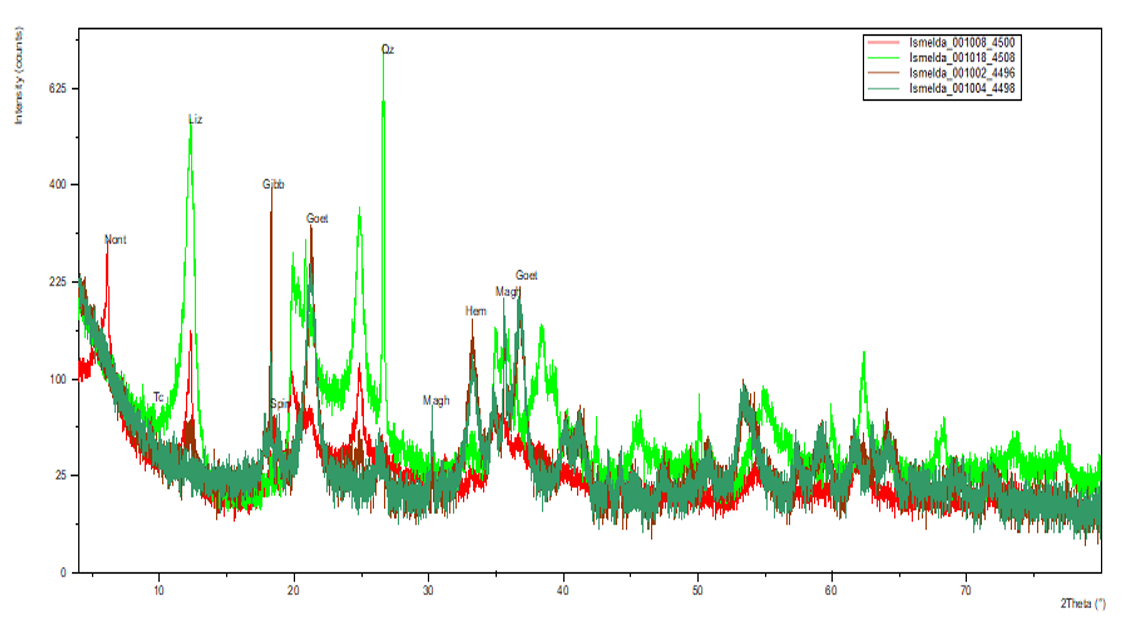
The petrographic and mineralogical characterization of the Yagrumaje Sur lateritic deposit was carried out, with the objective of determining the presence of rare earth elements and other metals of interest. Composite samples were taken in seven mineralogical wells drilled in the research area. The samples were analyzed using X-ray diffraction, optical mineralogy, petrography and chemical analysis by ICP-OES, for 19 chemical elements. It was concluded that the rocks of Yagrumaje Sur are represented by ultrabasic protolith metamorphic rocks (harzburgitic and lherzolitic serpentinites) and low pressure metamorphic rocks, specifically amphibolites and anorthosites (basic rocks), belonging to the gabroid group. The following mineral paragenesis are identified: olivine – serpentinitic minerals – metallic mineralization (in rocks metamorphosed by peridotites), plagioclase – clay minerals due to plagioclase alteration (in leucocratic rocks) and hornblende – tremolite – clay minerals (in amphibolites). Anomalous concentrations of cerium (145.73), lanthanum (226.52), neodymium (178.89) and yttrium (673.76) were revealed in the crust by maphites, exceeding 4 times the value of clarke. In the limonite horizon, scandium has a concentration of 110.52 ppm. The anomalous contents of the ETR in the studied areas increase the potential value of lateritic resources.
Article Details

This work is licensed under a Creative Commons Attribution-NonCommercial 4.0 International License.
Those authors who have publications with this journal accept the following terms:
- The authors will retain their copyright and guarantee the magazine the right to first publish their work, which will be simultaneously subject to the Creative Commons 4.0 Recognition-NonCommercial Recognition License that allows third parties to share the work whenever it is indicate its author and its first publication this magazine. Under this license the author will be free from:
- Share - copy and redistribute the material in any medium or format
- Adapt - remix, transform and create from the material
- The licensor cannot revoke these freedoms while complying with the terms of the license
Under the following conditions:
- Recognition - You must properly recognize the authorship, provide a link to the license and indicate if changes have been made. You can do it in any reasonable way, but not in a way that suggests that you have the support of the licensor or receive it for the use you make.
- NonCommercial - You may not use the material for a commercial purpose.
- There are no additional restrictions - You cannot apply legal terms or technological measures that legally restrict what the license allows.
- Authors may adopt other non-exclusive licensing agreements for the distribution of the version of the published work (e.g., deposit it in an institutional telematic archive or publish it in a monographic volume) provided that the initial publication in this journal is indicated.
- Authors are allowed and recommended to disseminate their work through the Internet (e.g., in institutional telematic archives or on their website) before and during the submission process, which can produce interesting exchanges and increase citations. of the published work. (See The effect of open access).
The magazine is not responsible for the opinions and concepts issued in the works, they are the sole responsibility of the authors. The Editor, with the assistance of the Editorial Committee, reserves the right to suggest or request advisable or necessary modifications. The mention of trademarks of specific equipment, instruments or materials is due to identification purposes, there being no promotional commitment in relation to them, neither by the authors nor by the publisher.
References
Adamovich, A. & Chejovich, V. 1962. “Principales características de la geología y minerales útiles de la región norte de la provincia de oriente”. Revista Tecnológica. Universidad de Oriente.
British Geological Survey. 1999. Rock Classification Scheme.
Casco, A., Torres-Roldán, R.L., Iturralde-Vinent, M.A., Millán García, G., Núñez-Cambra, K., Lázaro, C. & Rodríguez-Vega, A. 2006. High pressure metamorphism of ophiolites in Cuba. Geologica Acta, Vol. 4 (No.1):63–88.
Colectivo de autores. 2019. Sistema de Clasificación de las Rocas cubanas. La Habana, Cuba: Centro Nacional de Informacion Geologica, ISBN: 978-959-71176-91-9.
Coleman, R., 1977. Minerals and Rock, Ophiolites. Ancient Oceanic Lithosphere, Vol. 12: S.l. Springer-Verlag, Berlin.
Coleman, R.G. & Donato, M.M., 1979. Oceanic plagiogranite revisited. Developments in Petrology. S.l.: Elsevier, pp. 149-168.
Coleman, R.G. & Keith, T.E., 1971. “A chemical study of serpentinization—Burro Mountain, California”. Journal of Petrology, vol. 12 (No. 2) : 311-328.
Coleman, Sidney, 1977. Fate of the false vacuum: Semiclassical theory. Physical Review D, Vol. 15(No. 10):2929.
Fonseca, E., Zelepugin, V. N., & Heredia, M. 1985. Structure of the ophiolite association of Cuba. Geotectonic, 19:321-329.
Iturralde-Vinent, M.A., 1989. Role of ophiolites in the geological constitution of Cuba. Geotectonics, Vol. 4: 63-74.
Iturralde-Vinent, M. A., 1996. Cuba: el arco de islas volcánicas del Cretácico. Ofiolitas y arcos volcánicos de Cuba. IGCP project, 364, 179-189.
Joan-Carles Melgarejo & Colectivo de Autores. 2020. Atlas de asociaciones minerales en lámina delgada.
Lavaut-Copa, W. 2015. “Las bajas concentraciones metalíferas: Reto de la actividad minero-metalúrgica cubana”. Revista Geoinformativa, Vol. 9 ( No 1):12-21.
Le Maitre et al. 1989. Clasificacion modal de las muestras de rocas igneas . Según la I.U.G.S.
Muñoz-Gómez, J.N., Rodríguez-Infante, A. & Barea-Pérez, I., 2015. “Variabilidad de los perfiles lateríticos en los yacimientos ferroniquelíferos de Moa”. Minería y Geología, Vol. 3.
Proenza, J.A, Gervilla,F. & Melgarejo, J.C. 1999. “La Moho Transition Zone en el macizo ofiolítico Moa-Baracoa (Cuba): un ejemplo de interacción magma/peridotita”. Revista de la Sociedad Geológica de España 12 (3-4):309-327.
Quintas, F. 1989. Estratigrafía y paleografía del cretácico superior y paleógeno de la provincia Guantánamo y zonas cercanas. Tesis Doctoral, Fondo geológico ISMM, Cuba.
Strekeisen, AL. 1967. Clasificación y nomenclatura rocas ígneas. N. Jb. Miner.